Welcome to the web-site of Simon Pascal Klein, concept, graphic, and interface designer.

Proudly bending beziers since 2006

Articles in limbo and ALA web survey

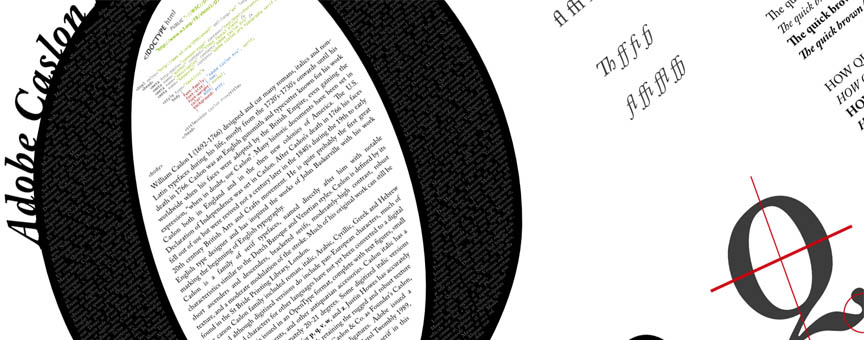
Whose Garamond is it anyway?

If you flick through various foundry catalogs for a Garamond revival or adaption, you’re probably bound to discover more than garalde typefaces. Interspersed amongst the many Garamonds by Claude Garamond (or Garamont) you’ll find baroque faces works by another type designer, Jean Jannon…

I wanted to cover this little typographic affair but quickly found the article gaining length and arguably bloat. It’s currently in limbo—I can’t decide whether to trim or polish it. Should I go ahead with a large but more interesting article (including a brief history French printing—which is interesting in my opinion) or go for the concise shorter version? Bah.

I also found that I’m short in garalde typefaces. Accompanying the article I’d prefer to offer garalde (and baroque) samples other than Garamond Premier Pro that’s on my Mac. Anyone with Bembo or another “Garamond” revival—either one by Garamond or Jean Jannon?

A List Apart

The Survery, 2008

ALA Survey 2008
ALA is again running their annual survey calling all those who work in the process of creating websites. The survey closes on Tuesday the 26th of August—have you taken part?

Putting Our Hot Heads Together

“If more of us are thinking ‘What can I contribute?’ instead of ‘Did I like this article?’ the entire conversation is transformed.”

Punctuation changes made to retain sequential quoting.

I also wanted to recommend article No. 265 Putting Our Hot Heads Together by Carolyn Wood. She offers a number of practical suggestions in nurturing collaboration in discussion and comment threads that appear obvious, but only after reading. Her writing style makes the piece a pleasure to read. Make sure to check that out.

Vivien’s review

In closing I also should pass on my thanks to Vivien from inspirationbit.com who kindly critiqued KLEPAS.ORG for me. Her thoughts and those that arose in the comments are going to help shape version 3 of this site; I’ve removed the clashing purple a:visited styling. Thanks again Vivien!

LugRadio Live and Silverback

Yesterday’s entry regarding the great Australian Firewall was probably less interesting for anyone outside of Australia. The post was the result of a quick letter of concern that needed writing and consequently publishing (it’ll probably do more good online than in the inbox of the Minister I sent it to). That out of the way, I’ve been meaning to write about my time in England, in particular the visit to LugRadio Live ’08 UK.

LugRadio Live

LugRadio was the premier open source/free software podcast featuring the Internet’s Jono Bacon, famous web developer Stuart ‘Aq’ Langridge, and sysadmins Adam Sweet and Chris Proctor. The second season ended with a weekend live recording and conference, ‘LugRadio Live’, in Wolverhampton, UK.

Following the initial announcement that LugRadio were to conclude their show at the end of season five (to the dismay of the many listeners including myself), this year’s LugRadio Live (LRL) in the UK was to be the last ever given the podcast had come to an end. It was therefore a must attend.

LugRadio Live was literally a rocking event—rock music blared from the speakers half the time and there was a true “Chinny Raccoon” (LugRadio’s mascot), a custom made raccoon outfit as worn by Ben Thorp. Both the exhibitions and talks were all of a high calibre of which Bruno Bord’s talk “Baguette on Snails” probably being the top highlight. The show—the final episode of LugRadio—was of course also a good laugh, and for those who were by chance bored Bytemark’s portably gaming center ensured there was something to kill time with.

Of course the news is that due to the strong persuasion of fans LRL will continue to run annually despite the conclusion of the podcast. Given it’s the premier open source/free software event in the UK, it would have been a great loss to the community if this just past LRL was indeed the final one. To get a feel for what the event is like check out Flickr photos and make sure you try to make it next year.

Recordings of the talks should make their way online within the next few weeks. I presented on the Tango Desktop Project—particularly on the re-licensing into the public domain. I was originally going to demonstrate the creation of Tango-styled icons but decided in the last minute to alter the focus of the presentation. I think I disappointed some people with the move—if I make it to next year’s LRL I’ll submit another paper.

Silverback

I suspect that the word would have traveled far across the Intertubes that Silverback is now out and available (it was even mentioned by Leisa Reichelt at GUADEC), so I won’t mention it for long here. Silverback is a USD $49.95 program by Clearleft that turns a Mac into a mini portable usability testing lab—for the price it’s a must-have for anyone working in the fields of usability and accessibility in the software & web production industry. Although it doesn’t give you the amount of data that a specialised usability testing lab might provide, Silverback doesn’t cost an arm and a leg, it’s as portable as your Mac and suits every use case I’ve ever needed.

I did run into a small issue regarding licensing after my purchase: I used a friend’s credit card and with no option to purchase the license for another, my friend whose name was the credit card holder was the subsequent recipient licensee—not myself. For taxation purposes and simply for the sake of correctness I started a discussion on Clearleft’s GetSatisfaction.com pages regarding the issue. I received an email response within thirty-six hours of the post and had the issue sorted out in no time. Thanks to Sophie over at Clearleft for the help.

Silverback main window

There are a number of reviews of Silverback—by Jonathan Christopher, .net magazine, and graphiceyedea—check them out if you’re unconvinced and otherwise have a great weekend.

Internet content filtering: outdated remedies applied to modern issues

Part of the hot-air during the Australian 2007 Federal Elections was the issue of Internet content filtering, which I waved off as just what I thought it was—hot-air—designed to impress and hopefully secure votes. The idea was shot down then and quickly was left alone … until now. Ashley Kyd drew this to my attention in his article Australia’s “Clean Feed”:

“The Australian Federal Government is powering full steam ahead on a $125.8 million dollar plan to enact a mandatory content-filter every single Australian Internet connection. Subtly different from the Great Firewall of China, the Australian version is to be implemented at ISP level, and will target not only illegal content, but also “inappropriate” content unsuitable for children.

The ACMA has submitted a report on the current state of the tech to Senator Stephen Conroy — so called ‘Minister for Broadband, Comm­unications and the Digital Economy’ — who’s hailing it as a modern miracle, despite what can only be seen as a startling lack of comprehension of the real world implications.”

Punctuation changes made to retain sequential quoting.

So, I got off my butt and wrote an email to Stephen Conroy. Because I doubt it will ever get past his secretary and meet Mr. Conroy’s own eyes due to his likely busy schedule I am publishing this here in the hopes that any Australians—or even Australian permanent residents (I am one)—who see this might consider voicing their concerns to the Government. The letter:

Dear Minister Stephen Conroy,

As an employed Australian permanent resident—and web & Internet professional—I have serious reservations about your new mandatory “clean feed” filter initiative.

Pursuing an expensive $125.8 billion million dollar venture that entirely fails to address the security, speed, quality of any such a filtering system, as well as the rights of both website owners in and outside of Australia and finally the civil rights of the citizens of Australia is a waste of tax payers’ money and of serious concern to every Internet user in Australia.

Concerning security, I am shocked that the report claims six of the seven solutions tested filter the HTTPS protocol (HyperText Transfer Protocol over Secure Socket Layer)—the protocol over which Australians make secure Internet banking and e-commerce transactions. This communication protocol was inherently designed specifically to promise a set level of security and privacy for its users. Furthermore, as this is a secure protocol, any filter—by logical conclusion—must use a simple keyword, or “blacklist” method which has been proven both ineffective, slow, incredibly arduous to keep updated and also prone to blacklist (block) legitimate content.

In regards to speed, the July 2008 study clearly indicates that a high-speed, accurate filtering solution is not possible. Therefore implementing any such filtering at the ISP (Internet Service Provider) level will only hamper and slow down the current infrastructure—which greatly needs speed improvements, not declines.

As noted above a blacklist filter is of serious concern to security and speed, both of which are important elements of any such a system’s quality level. The higher the blocking accuracy of such a system, the more it well hamper the speed of the network infrastructure.

If such a system is implemented I believe the Australian Government will anger and frustrate many website owners both overseas and locally. Processing blacklist removal requests will be a major undertaking that will incur continuous monetary, time and implementation costs. I believe many web content owners will consider their legal options in regards any such a move by the Government. At the very least a one-size-fits-all filtering approach as the one proposed will cast the Australian Government in a very negative light, abroad and at home.

Finally—any most importantly—I believe the Australian Government has absolutely no role in monitoring and deciding what is appropriate for myself, our children—a fact that many Australians will undoubtedly agree with.

I believe the Internet is a technology that will test society and its legal systems—common issues that have arisen include content censorship (as on the table currently), copyright, licensing and patenting, universal access availability, and more. Many of our legal systems are outdated in respect to the advances of the digital age, and this current issue is just another hurdle to be overcome as we realise we must shift our attitudes; no body will be successfully able to control and filter the expanse of information present and growing on the Internet. Any such a venture is futile, expensive and will only cause distress.

The expansive resources—125.8 billion million dollars for example—available to the Australian Government instead be focused on providing up-to-date education on Internet technologies both to students and parents to ensure we can make well-educated judgements about how we spend our time on-line.

Our digital infrastructure has been the hot-topic before, during and now as it seems even after the election—I sincerely hope the Government will reconsider this initiative and make an informed decision that takes the needs of Australians at heart.

Your sincerely,

Simon Pascal Klein
Canberra, Australia

Opera Web Standards Curriculum

Opera recently released a set of succinct educational articles on the foundation of the web, standard technologies and well-written introductions to vital web design topics, aptly titled the Opera Web Standards Curriculum (WSC).

At first I asked myself why something like this was necessary in the year of 2008—don’t students get taught web standards through college and univeristy these days? If not, aren’t there already are number of good resources available, free and commerical? I had a bit of a read, starting right at the beginning and found partially the answer in the fifth article:

“…The general feeling I get from looking at numerous university courses is that web languages like HTML, CSS and JavaScript are below the technical threshold of most computer science programs, and above the technical threshold of most MIS/New Media programs.

What I’m getting at here is that many educational courses don’t cover this kind of stuff in any great level of detail. I would be willing to wager that if you ask 10 developers that work with web standards where they learned how to use web standards that 9 of them would reply that they are self-taught (the other 1 won’t answer you because she’s too busy trying to get her site to render properly in IE6).”

Previously defined acronyms earlier in the quoted text have been redefined.

I started an IT course in college that focused on publishing content onto web-based mediums in early 2006. I was told we would not touch CSS until the end of the second year, and mention of web standards was not to found in the entire curriculum document. I promptly left the course. As Jonathan Lane points out, most standards-based web designers and developers are probably self-taught—I am.

But why another set of articles ontop of the many resources that already exist? Because commonly it’s scattered across the Internet or because you’d need to purchase books (and in the case of students, those university text books can be quite pricey). The neat thing about web design and developement is that articles like those from the WSC appear in the same canvas we work on and consequently offer interactive examples—and best of all are freely accessible. Books can be nice—particularly well set ones—but for someone just starting with web standards beginning with the WSC marks a good beginning.

The WSC doesn’t go into great technical detail. Instead, it offers the background information that is often omitted from the more technical articles on developer blogs or on related publications. Something like this would have been great in place of the IT course I entered a few years ago.

Apart from being an introduction to the creation of the Internet, how it came to be what it is now and why standards are good for everyone, the WSC also features introductory articles on information architecture, accessibility, usability and content context, colour theory, wireframing, assorted mockup tips and last (and best of all), an article on web typography.

The Opera WSC will probably be my future recommendation for newcomers to web standards, HTML, and the selected articles above. I would even recommend them to the experts—pick a topic you haven’t dealt with in a while and make sure you’re up to scratch (there are a few questions at the end of each article).

Kudos to Opera.